

 Streamline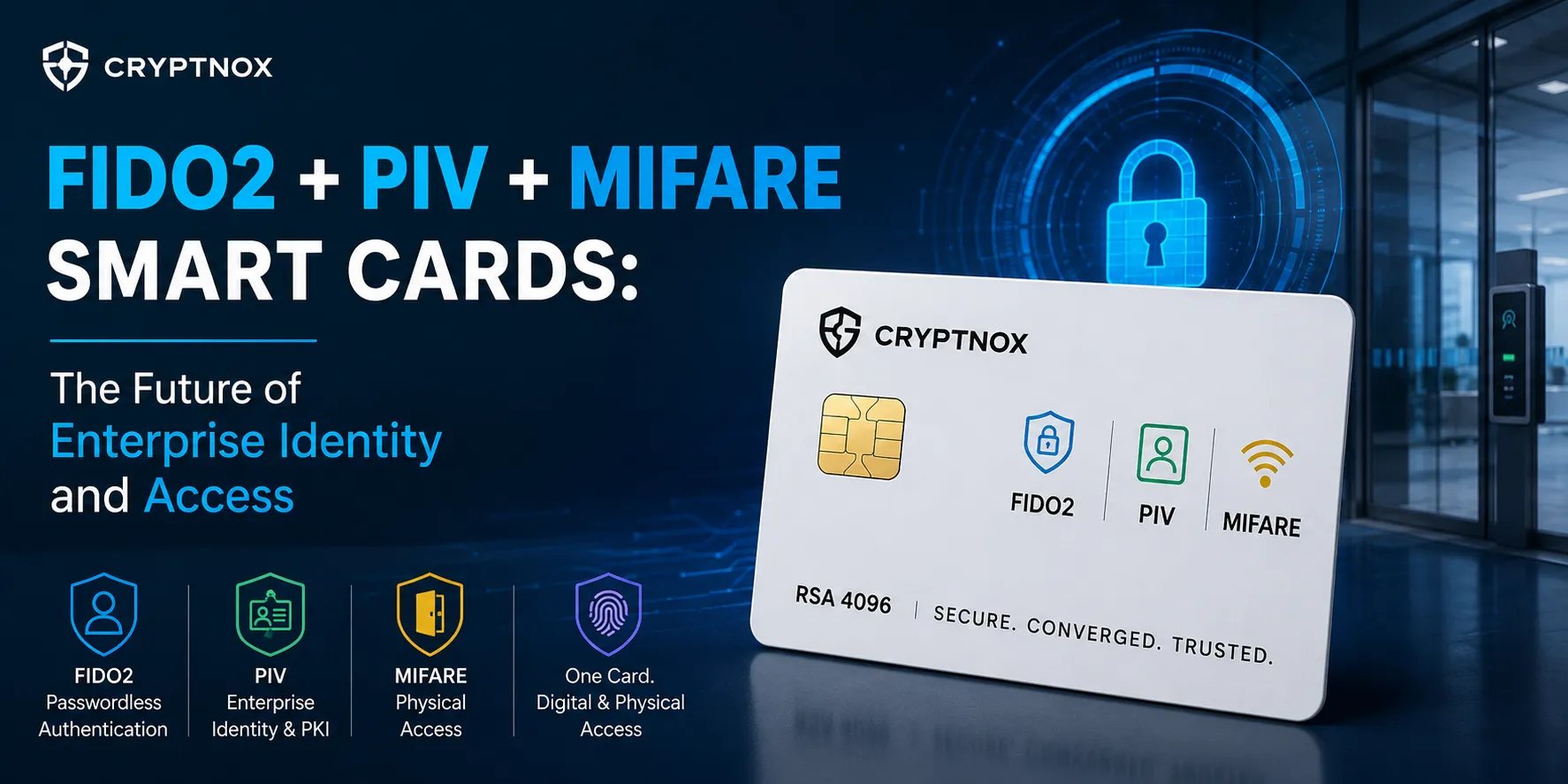
Enterprise security is becoming increasingly complex as organizations manage cloud applications, employee devices, corporate networks, and physical facilities. Traditional passwords and separate access badges can create fragmented security processes, while employees may need multiple credentials to access different systems.
A FIDO2 PIV MIFARE smart card brings several enterprise security functions together in a single credential. FIDO2 can support modern passwordless authentication, PIV provides certificate-based identity and authentication capabilities, and MIFARE technology can support physical-access applications. Together, these technologies create a more unified approach to enterprise identity and access management.
For organizations looking to reduce credential sprawl while strengthening authentication and access controls, combining these capabilities into one smart card can be a practical approach.
What Is a FIDO2 PIV MIFARE Smart Card?
A FIDO2 PIV MIFARE smart card is an enterprise credential that combines three distinct technologies designed for different security requirements.
FIDO2 is associated with modern passwordless authentication and phishing-resistant authentication mechanisms. It can help employees securely access compatible applications and services without relying solely on passwords.
PIV, or Personal Identity Verification, provides a framework for using smart-card credentials and digital certificates for identity verification and authentication. PIV credentials are particularly relevant to enterprise environments that use PKI-based authentication.
MIFARE technology is commonly associated with contactless credentials and physical-access applications. Depending on the implementation, it can support employee identification and access to controlled areas.
The result is a multi-purpose credential capable of supporting both digital and physical identity use cases.
Why Combine FIDO2, PIV and MIFARE?
Organizations often operate separate systems for logical access and physical security. Employees may use one credential for computer authentication, another for VPN access, and a separate badge for entering offices or restricted areas.
A FIDO2 PIV smart card can help reduce this fragmentation by bringing complementary authentication capabilities together.
The three technologies address different requirements:
-
FIDO2: Modern passwordless and strong application authentication
-
PIV: Certificate-based enterprise identity and authentication
-
MIFARE: Contactless physical-access and credential applications
This approach can make employee credentials easier to manage while giving security teams a more centralized identity strategy.
FIDO2 for Modern Enterprise Authentication
Passwords remain a significant security challenge because employees may reuse them, choose weak credentials, or accidentally disclose them through phishing attacks.
FIDO2 provides a modern authentication framework designed to reduce dependence on passwords. Compatible authentication systems can use cryptographic credentials rather than requiring users to provide a traditional password during every login.
A FIDO2 PIV MIFARE smart card can therefore support organizations transitioning toward passwordless authentication while maintaining a physical credential employees already understand.
For example, an employee could use a compatible smart card as part of an authentication process for enterprise applications, reducing reliance on passwords and strengthening the organization’s authentication architecture.
PIV for Enterprise Digital Identity
PIV provides another layer of functionality focused on verified enterprise identity and certificate-based authentication.
A PIV MIFARE smart card can incorporate digital identity capabilities alongside physical-access functionality, making it useful for organizations that depend on PKI infrastructure.
PIV credentials can be used in scenarios such as:
-
Enterprise computer authentication
-
Certificate-based Windows authentication
-
Active Directory environments
-
VPN authentication
-
Digital signatures
-
Secure email applications
-
Certificate-based network authentication
The key advantage is that identity credentials can be protected by dedicated hardware rather than relying entirely on software-based credential storage.
Hardware-Backed Identity
Hardware-backed credentials can provide an additional security boundary for sensitive authentication material. Instead of keeping important credentials exclusively within the operating system or application environment, smart-card technology can protect cryptographic operations within dedicated hardware.
This makes an enterprise identity smart card particularly relevant for organizations with strict identity and access requirements.
MIFARE for Physical Access
Digital authentication is only one part of enterprise security. Organizations also need to control access to offices, restricted areas, server rooms, laboratories, and other physical facilities.
MIFARE technology is widely associated with contactless credentials used in physical-access systems. Integrating this capability into an employee credential can help organizations move toward a more unified identity model.
Instead of issuing separate credentials for digital systems and building access, organizations can explore a converged identity smart card that combines logical and physical access capabilities.
For example, an employee could use one credential for authorized computer access and, where supported by the organization’s access-control infrastructure, use the same credential for entry into approved physical areas.
The Benefits of a Converged Employee Credential
A combined credential can offer several operational advantages.
Reduced Credential Sprawl
Employees carrying multiple cards can create unnecessary complexity. Combining authentication and access functions into one credential can simplify everyday workflows.
Simplified Credential Management
IT and security teams may be able to streamline credential issuance, replacement, and lifecycle management when multiple functions are associated with a single employee identity.
Stronger Authentication Architecture
Combining FIDO2 and PIV can give organizations access to both modern authentication and certificate-based identity mechanisms, depending on their infrastructure and application requirements.
Digital and Physical Access in One Credential
A combined enterprise authentication badge can connect digital identity with physical access, supporting a more unified approach to employee security.
Where FIDO2 + PIV + MIFARE Smart Cards Can Be Used
The technology can be relevant across organizations that require both strong digital authentication and controlled physical access.
Potential use cases include:
-
Corporate offices
-
Financial institutions
-
Government organizations
-
Healthcare facilities
-
Technology companies
-
Research environments
-
Data centers
-
Educational institutions
-
Industrial facilities
For instance, a company could use FIDO2 for supported application authentication, PIV certificates for enterprise identity workflows, and MIFARE functionality for compatible physical-access systems.
The exact capabilities available will depend on the organization’s identity infrastructure, certificate authority, access-control system, and supported applications.
Is One Smart Card Better Than Separate Credentials?
Not necessarily in every environment. The right approach depends on existing infrastructure, security requirements, compliance obligations, and compatibility.
However, combining FIDO2, PIV, and MIFARE can provide a compelling option for organizations seeking to reduce the number of credentials employees must carry.
A FIDO2 PIV card can serve as part of a broader identity strategy where passwordless authentication, certificate-based identity, and physical access need to coexist.
Organizations should evaluate interoperability, credential lifecycle management, authentication policies, certificate infrastructure, and physical-access compatibility before deployment.
Conclusion
A FIDO2 PIV MIFARE smart card represents a converged approach to modern enterprise identity and access management. FIDO2 addresses passwordless and strong authentication, PIV supports certificate-based enterprise identity, and MIFARE can support compatible physical-access applications.
Rather than treating digital authentication and physical security as completely separate systems, organizations can explore a unified credential strategy that simplifies employee access while supporting stronger security controls.
For enterprises managing complex identity environments, the combination of FIDO2, PIV, and MIFARE provides a flexible foundation for connecting digital authentication, trusted identity, and physical access through a single smart-card credential.
